Add, manage and set up payment methods
We'll show you how to add new payment methods and edit them individually with ready2order!
Overview of payment methods
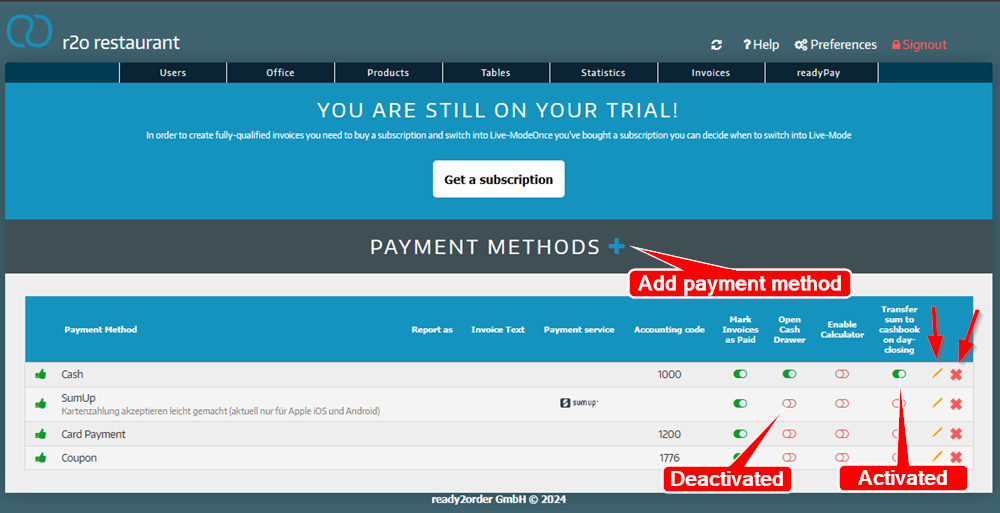
In the Products tab, click on Payment Methods and you will be taken to an overview of your payment methods. Here you will see a list of the different payment methods, as well as invoice texts, account numbers, etc.
If the buttons in the overview are green, these options are activated for the respective payment method. You can activate or deactivate them by editing them.
You can edit the payment method using the yellow pen on the right.
You can delete the payment method using the red X.
Add payment method
Click on the blue + next to payment methods.
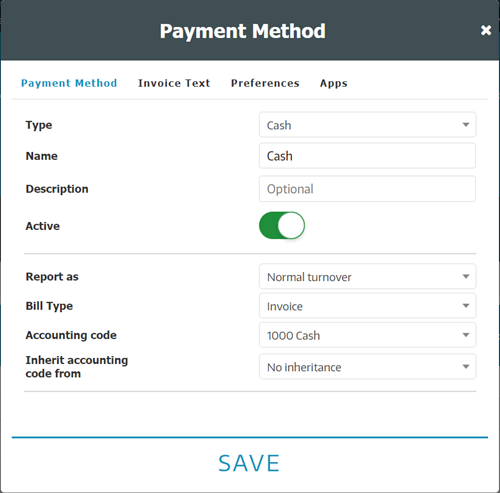
Now you have to fill in the following fields:
- Type : What type of payment is it?
- Name : Name the payment method
- Description : Describe the payment method (optional)
- Active : Activate the payment method
- Report as: Identify the payment method
- Normal turnover: The value of goods and services sold in a period
- Advertising expenses: Expenses of a company for advertising purposes
- Own consumption: Use the point Personal Consumption if you consume the product yourself
- Personal consumption: Use this point if the product is used by your staff
- Fraction: The product was damaged during manufacturing, packaging or handling
- Loss: Loss of goods
- Bill type : Create a document group
- Invoice: An invoice is used to bill deliveries or other services to a customer
- Cash receipt: A payment is made by cash
- Outgoing invoice: If you issue an invoice to a customers , this is an outgoing invoice. You can use this document group for payments on account
- Outgoing credit memo: The credit note is an invoice that is issued by the service recipient. Here you issue a credit note to your customers
- Incoming credit memo: Here you will receive a credit
- Bank Transfer: A sale that follows by bank transfer
- Fee note: A fee note is a receipt that is issued primarily by freelancers (doctors, lawyers, tax consultants) for their services in order to invoice the costs for these activities
- Proof of payment: A payment receipt serves as proof of payment or as a receipt for accounting purposes. These should always be kept
- Accounting system
- Accounting code : Enter an account
Payment settings
Here is how you set up a payment method:
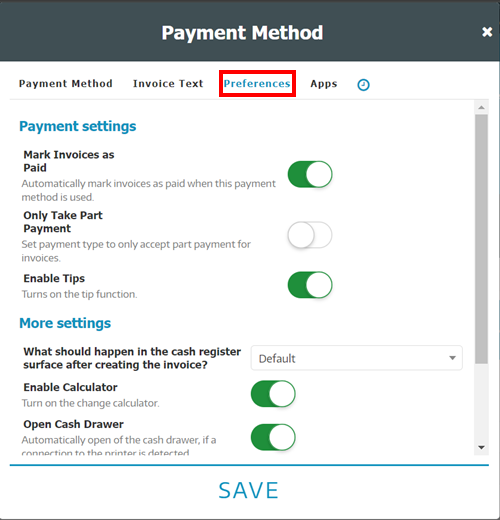
- Edit the payment method you want by clicking the yellow pencil.
- Click the Settings tab. The settings are grouped into Checkout Flow and Payment.
Checkout Flow
Mark invoice as paid:
Switch this on if invoices should be marked as paid automatically when this payment method is used. Switch it off if you want to use the payment method for payments on account (see the section below).
Tip selection in the POS:
Switch this on so your staff can record a tip when taking payment.
Enable change calculator:
Switch this on to enable the change calculator, which helps your staff work out the change quickly.
Open cash drawer:
Switch this on so the cash drawer opens automatically when the payment is completed.
What should happen in the cash register surface after creating the invoice?
Select the action you want from the dropdown menu.
Standard number of print copies:
Select how many invoice copies should be printed automatically.
Use purchase prices:
Switch this on to use the purchase price instead of the sales price when settling (e.g. for internal billing).
Payment
IBAN and Name of bank account holder:
Enter the bank details that should apply to this payment method. Both entries are used for the e-invoice and for the payment QR code.
Show payment QR code:
Switch this on to add a QR code for bank transfer to the invoice. The QR code only appears if the IBAN and the name of the bank account holder are filled in.
Only take part payment:
Switch this on if the payment method should only be shown for partial payments.
Zero receipt:
Switch this on to set all invoiced items to a price of 0.00.
Click SAVE at the bottom of the dialog to apply the changes.
Payment on account
If you want to offer your customers the option to pay on account, you must enter this option as a payment method. To do this, you create a new payment method, but you must deactivate the option "Mark invoice as paid" under settings.
You now have a second tab under your payment methods: "Payment receipt". Here you can enter the payment methods that you can select to mark an invoice as paid on account!
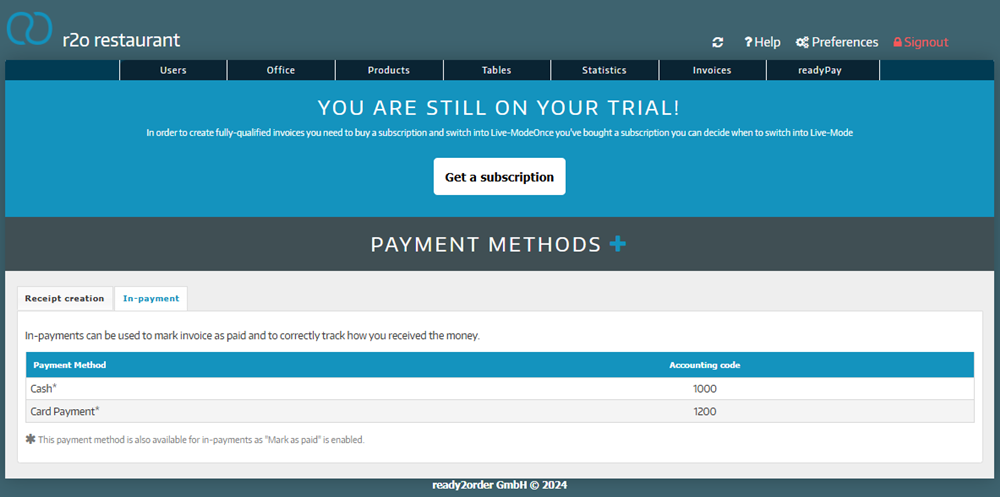
To add a new payment method to "Payment receipt", click on the blue plus. A pop-up will open where you can select whether you want to create a payment method for receipt creation or for payment receipt.
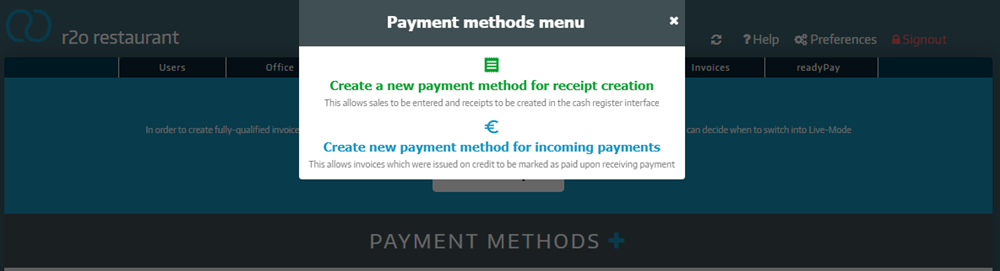
Select "Create new payment method for incoming payments" so that you can later use this payment method exclusively to "Mark as paid" invoices on account, but it will not be displayed in the checkout interface.
Now give the new payment method a name, for example "Receive transfer".
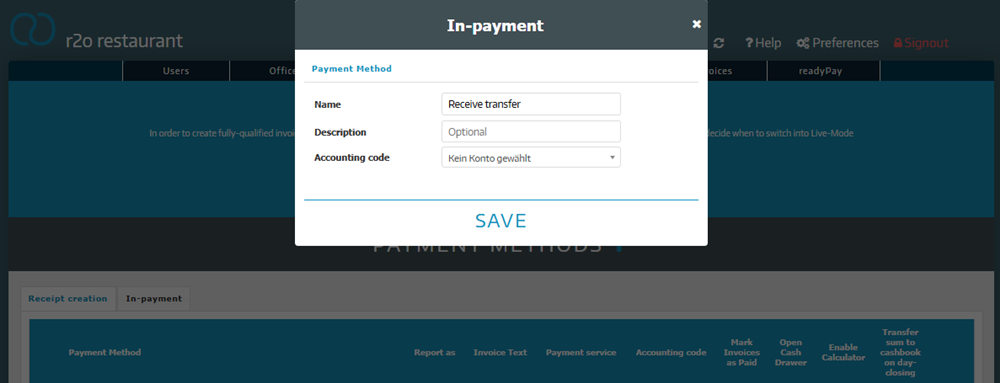
Description and account number (for accountancy export) are optional. In case of "Receive transfer" it is recommended to enter the accounting account of your bank account.
